
The Southern Front and Hulyiaipole
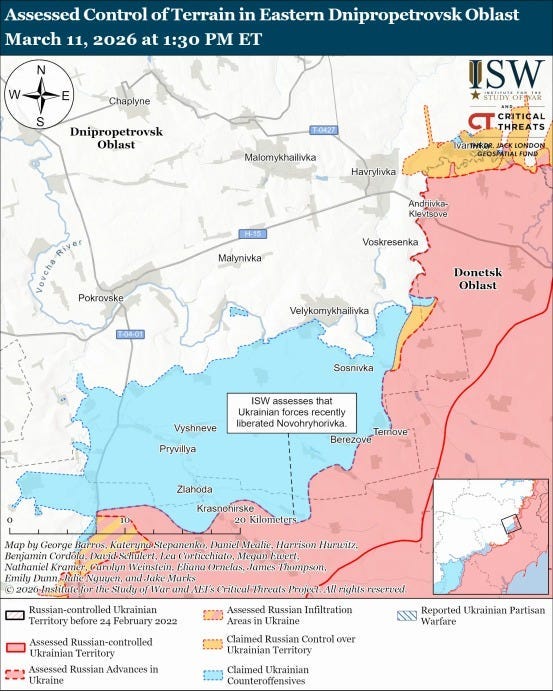
The ZSU this week claimed it had cleared all Russian forces out of Dnipopetrovsk region, which seems probable but it’s not confirmed. The 225th Skala Regiment reported it liberated the village Ternove and posted video showing BMPs, HUMMV, Quadcycles loaded with infantry and supposedly moving to the attack. The quadcycles had three guys each. Kit was winter camo smocks, Alice pack/big packs, day packs, sleeping pads, drone nets and explosives. Lots of small arms. No anti-tank weapons that I could see. The 225th said they picked up 10 kilometers against weak resistance, the “fighting” was clearing mostly empty buildings.
The ISW on Thursday agreed with the reports and posted pretty substantial Ukrainian gains in the Dnipropetrovsk sector SE of Pokrovske, and reported the most recent village liberated was a place called Novohryhorivka, whose main importance is that it’s in mortar and even AGS and heavy machine gun range from the Huliaiapole-Novoselivka road and more importantly the village cluster Priyvi’ne-Pavlikva-Uspenivka-Novovasyilvske-Novomyhailiva, and a bridge there crossing the Yanuchur River. I assume the Ukrainian idea is to reach the river line before the Russian Spring Offensive the sector kicks off, so as to have a bunch of villages and a river line to defend from. So although the ISW map shows a bunch of blue territory liberated, the real news I would say is that the ZSU is picking its offensive battles pretty carefully and it looks to me like there’s operational logic behind it.
I know all this talk about the ZSU deliberately and intelligently planning offensive operations implies the unfashionable narrative that Syrsky and the assault infantry regiments are inefficient holdovers from the Soviet era, which is pretty easy to hear in the ZSU, but success is success. Over the week several Ukrainian generals including Komarenko from the General Staff, who pretty much never speaks in public, said that operations in the south were proceeding satisfactorily and that the overall objective is sucking in Russian reserves and picking the ground for the Spring Offensive, which he and Syrsky said is definitely coming.
Pokrovsk
Are we to the three month mark that this city was supposed to have fallen under the undisputed control of the Russian army, but somehow that never worked out?
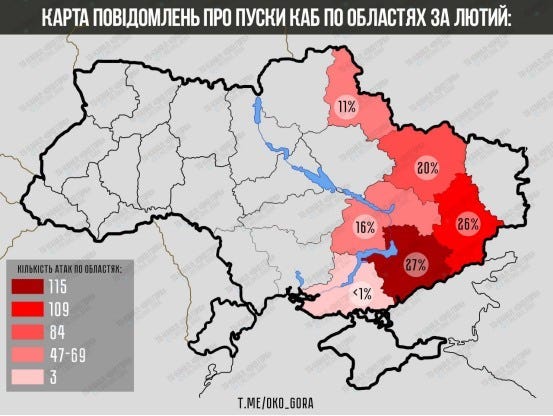
First thing, two weeks in a row now, Pokrovsk ISN’T the hottest sector of the front. I monitor 25th Airborne Brigade and the report there is that the Russians seem tired; they’ll fling inaccurate glide bombs from time to time but ground assaults have pretty much quit. Those are paratroopers talking so grain of salt on that. But across the front engagements are about 120–140/day; that’s about 40–50 percent less than in periods of intense fighting. Also: In February for the first month in years Donetsk region was not the top target for Russian glide-bombs attacks, it was Zaporizhzhia.
Generally the situation on the ground appears largely unchanged from what I can see, the Ukrainians are in the northern edge, the Russians in the southern edge, the kill zone in the middle, any soldiers anywhere near spend most of their time hiding. Activity is either side attempting to supply its infantry who are not so much holding defensive positions as occupying observation posts. The war is attacking each others’ supply efforts with drones.

Here’s a Ukrainian write up citing alleged Russian soldier radio transmissions:
The enemy complains in radio intercepts about the completely destroyed logistics in the Pokrovsky and Dobropillia sectors, the ZSU has created such conditions that it is almost impossible to move heavy armored vehicles and automobiles 10–15 km from the enemy’s LBZ. Because of this, the activity of assault operations in the directions has significantly decreased.
And here’s a Russian mil-blogger write-up of same thing, same place:
The successes of the (vulgar word for Ukrainians) isn’t just because Starlink got switched off, but also because of the radical increase of the FPV drones they use, that can fly really deep behind the line of the front. This has allowed them to create a real happy uniting ground not only in the 15 kilometer KillZone, but much deeper, and sometimes they fly up to 60 kilometers. This is not just fiber-optic cables, but specifically, drones using radio and satellite links. In some sectors this has led to the complete collapse of supply, and has stopped advances (by Russian forces) in practically all sectors. Overall a (vulgar)-up situation.
This is also a fair confirmation of reports last week that the Ukrainians had figured out how to operate drones on new and unexpected frequencies, rendering Russian jammers useless. This naturally leads to the speculation that the Ukrainians not only shifted their drones to frequencies the Russians couldn’t jam, but took steps to take advantage of the window (until the Russians built new jammers) by figuring out a way to operate extended-range drones that they couldn’t in the past. The normal usual suspects in that scenario are mother ship drones and repeater drones, but that is pure speculation at this point. However, see below.
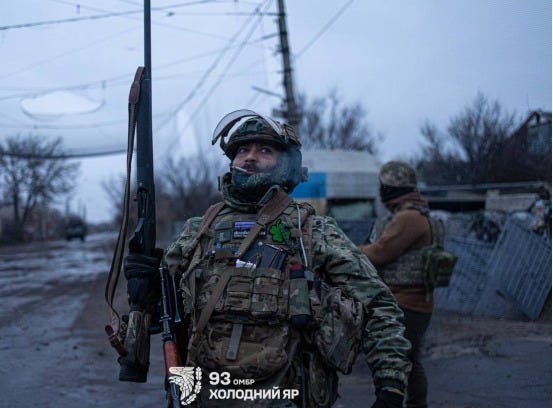
But also in a Donbas Realii interview a ZSU officer identified as Oleksander, mortar unit commander, call sign “Reno,” 68th Jager Brigade, said that Russian assaults in Mirgorod — north of Pokrovsk and one of the most outlying Ukrainian positions on the easter front — were all small scale. Dry ground and clear weather was allowing more Russian infantry moving forward to be spotted and hit, he said. The key actions were in “small aviation” where drones for either side are trying to dominate air space. The tactic here is to find the other side’s antennae, repeaters or operator crews and hit them. However, when the interviewer said video makes it look like Pokrovsk is empty of ZSU troops, he agreed. According to him drone supplies to ZSU units in his sector have improved somewhat, but, teams from the Russian drone “elite” unit Rubikon have showed up, so the air war is still a fight. This was published Thursday.
To the south of Pokrovsk/Mirgorod, in the Konstantinivka/Chasiv Yar sector, Russian forces used aerial bombs to blow up a dam and road crossing near Konstantinovka, so based on past patterns at some point we can expect Russian attempts to push into the city. This a a pretty sizable place with heavy industrial buildings and so it’s a decent stronghold, and a preliminary step to attacks on places like that is Russia cutting logistics. Tom Cooper and others have pointed out that judging by contrails and bomb strike locations the Russian air force seems to be pretty confident the Ukrainians have no long-range anti-aircraft missiles along the eastern front. This is probably true because of the city bombardment battles of the last four months.
What does it all mean? What will the Russians do next? That’s hard to say, clearly the intensity of attacks has been dialed down, although as always it’s not clear whether that’s because of nefarious plans or just shortages of men and equipment. But the activity we are seeing points towards more of the same: when they have resources they will try to push in Donbas and particularly Donetsk region because that’s an announced war aim. Meaning, if we’re guessing Spring offensive, it’s more likely to come in places they pushed in the past.
Ukrainian Assault Infantry Tactics — A Window
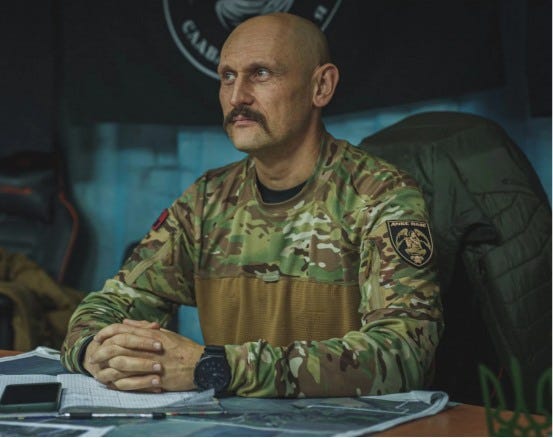
Dmytro Filatov, commander 1st Assault Regiment “Da Vinchi”, this week made some comments to media talking about fighting around Pokrovsk in January, and in the process offered a pretty good picture of how assault troops get “breakthroughs”. According to him, the key bit is “meticulous preparation.” I don’t know for sure these were the tactics used recently in Dnipropetrovsk sector, but probably they were, and in any case it’s one of the best descriptions we’ve seen in open sources on how Ukrainian assault infantry units do what they do. Filatov described a two-battalion attack that pushed into Russian lines 10–12 kilometers while other units effectively flooded the gray zone all around, making diversionary attacks, destroying reconnaissance, encircling Russian outposts and mopping them up.
By the description it seems like the attack had roughly a four kilometer front and besides just destroying enemy, the objective was to occupy new positions and then reinforce and consolidate faster than the Russians could respond. As the attack goes in, drone units concentrated behind it swarm the area around the selected assault area and destroy anything that moves. Artillery carries out planned and on-call fire strikes but it mostly depends on what’s Russian that starts moving in the vicinity and is spotted. The first step of the attack is a massed drone strike that swarms over the selected territory for attack and hunts targets.
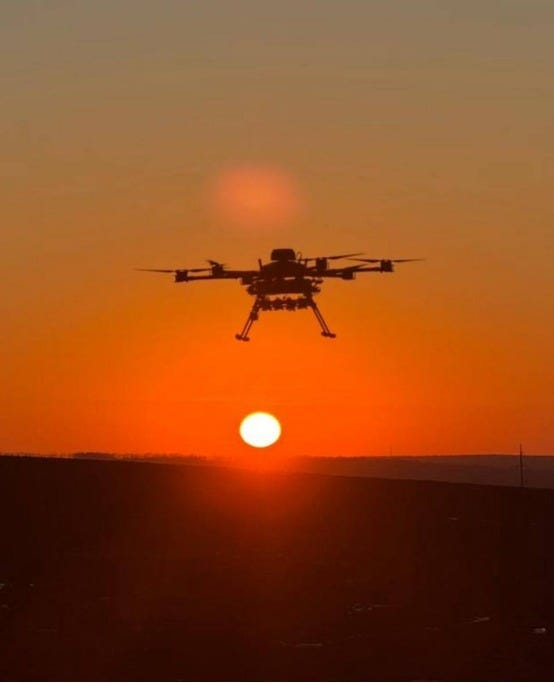
I came across a report from a Belarussian mil-blogger named Silovik reporting roughly the same process: first the sky gets filled up with Ukrainian drones and second once the ground troops follow the defenders have a real problem: stay put and they will be found in due course and beaten down with artillery or bomber drones, move and they will be found quickly and hunted down by FPV drones. The first drone wave, Filatov said, is 200–300 drones.
Both sides have used drone unit concentrations for some time to shore up sectors of the front, but this is a step forward: concentration of drone units to gain ground. There obviously is some complicated coordinating going on because there is the ground problem of moving a bunch of drone teams into a relatively small area, getting all of them set in hides, and the air problem of coordinating — it seems very possible — more than 100 bomber, observation, and FPV drones operating in a 5 x 5 kilometer air space.
I have no idea how the Ukrainians coordinate it, but I strongly suspect the ZSU technique is a general suggestion that everyone try not to crash into each other and a general hope everything will work out. In any case, this is an excellent case study of how far NATO and pretty much the rest of the world are behind the ZSU: Aside from them, I don’t think there’s an army on Earth that can launch a battalion+ deliberate attack combining arms with 200–400 military drones at the tactical level, and more than that, aside from the Russians I don’t know any army on Earth that could even plan it.
Don’t get me wrong, the soldiers themselves say that tanks and artillery aren’t obsolete, it’s just that drones are the decisive arm.
Now for some speculation. We can say for sure the Ukrainians are taking advantage of Elon Musk switching off the Russians’ Starlink, and we know from open sources a Russian crackdown on Telegram use (primarily to suppress dissent at home, but also for soldiers) had been coming. It is at least possible the Ukrainians had prior knowledge of these two developments and took steps accordingly, including possibly planning a counter-offensive built on local tactical advantage and reduced Russian ability to respond to an attack flexibly. Along with that, we know, because it was their equipment, that the Ukrainians at roughly the same time gained a significant tactical advantage in short- and medium-range drone operation, by putting into operation on new frequencies the Russians were, short term, unable to jam. Could it be that the Ukrainian mini counter-offensive that is now in progress, was intentionally timed to strike when (1) Telegram was mostly down for the Russians (2) Starlink was fully down for the Russians and (3) Ukrainian drone comms shifted to frequencies the Russians couldn’t jam?
Other factors helping out the Ukrainian attacks also are time-related, particularly wetter weather and fog. Yes, it’s a pretty long stretch to suggest that probably the Ukrainians waited until all those planets were exactly in line to strike, and that they manipulated the ones they could control to match the ones they could not. There certainly isn’t enough evidence to prove that’s what they did. But the Ukrainian track record for this war is absolutely clear: the more ambitious the operation, the more meticulously they prepare. My instinct is there are too many advantages working for the Ukrainians in the south right now for the timing to have been a coincidence. But let’s be clear, no proof.
More Medevac Robot News (And Some Drone News)
Yes, as Isaac Asimov predicted robots are becoming very popular because they are good at saving human lives.
Straight from the front, in the Pokrovsk sector, news came down the pike that a wounded soldier out at the very sharp end was evacuated 65 kilometers (!) by UGV, in a medevac that lasted almost an entire night. There was no other way to reach him and apparently this is now the new World Record Longest Range Medevac by UGV. The robot took a couple of near misses and a mine strike but made it. Patient rode in some kind of cocoon/protective container, those things are scary, they really remind you of a coffin. But better than dying on the line.
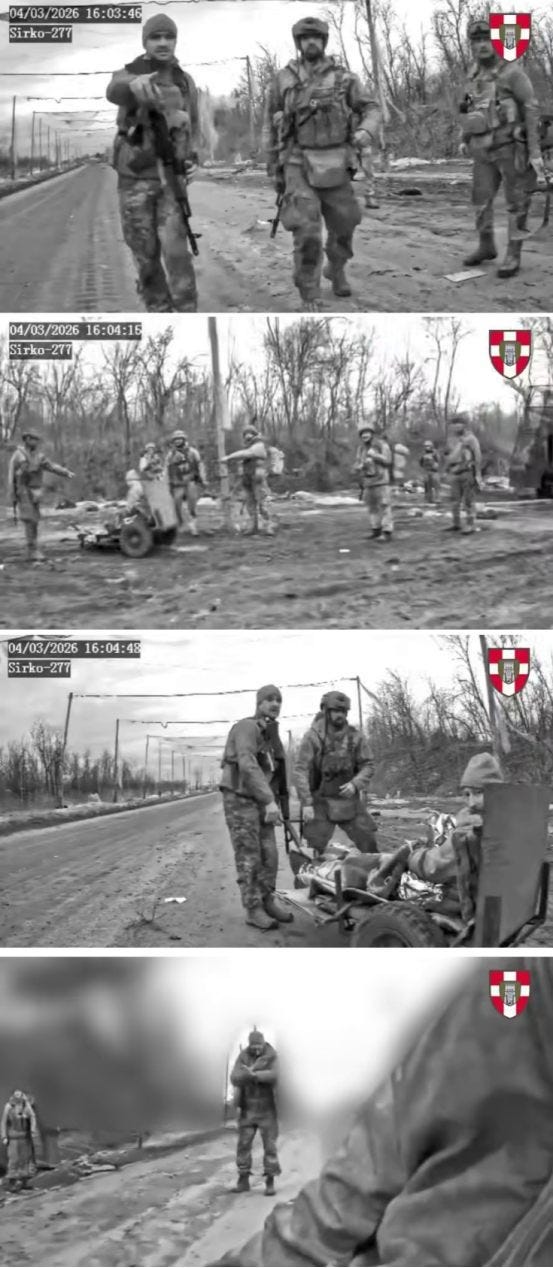
Then there was the evac on Mar. 4, Kostyantynivka. A Sirko-S1 was trundling its way back to friendly lines after delivering ammunition, food, and medicine to the soldiers of the 100th OMBR. On the way, it came across soldiers from another brigade who were trying to evacuate the wounded man. According to the 100th Brigade press announcement (with video), the exchange went link this:
Through the built-in speakers, the Sirko NRC operator: “Glory to Ukraine, soldiers! Do you need help?”
Soldier: “To the heroes glory! Yes!”
The run to the rear took 20 minutes at full speed “fleeing from Russian drones.”
In the attached image, this is a good illustration of how operations at the front aren’t as smooth and planned as military staff schools always teach they are, a logistics team from 100th Mechanized Brigade was moving one of its UGVs down a road, it encountered soldiers from another brigade with a casualty, communications were established via the UGV’s speaker/receiver, and the result as an ad hoc casevac by robot. Again, no other army in the world does this. Images are screenies from the video; my favorite shot is the medic with the cigarette.
Also, Ukraine drone stat for the week, Ukraine’s General Staff put some officers and spreadsheets on the task, and they calculated that friendly casualties where a unit is UGV/drone dense drop by about 35 percent. So know we know.
On Thursday the General Staff held a formal meeting on drone fielding and development, chaired by Syrsky, everyone agreed drones are a big deal and the ZSU needs more of them. Among the stats published:
In Feb. ZSU drones hit 105,000+ targets of all types
2,500 of those targets were Russian drone operators
The ZSU is developing its own cross-force fiber-optic drone but it isn’t finished
Ukraine still has the advantage over Russian in multi-rotor drone production, however, right now the Russians can manufacture 19,000 FPV drones a day.
There will be more drone interceptor units fielded in the ZSU
Training priority is drone pilots and particularly interceptor drone pilots
continued…
Excellent update. Detail on the Assault unit tactics particularly appreciated 👍
Thanks for the report.
From what I understand, drones seem to be today's close air support and precision artillery rolled in one package when assaulting?