April 20 — Day 56 — Easter offensive, Mariupol end game (maybe), lots of talk about weapons

Hi Facebook!
I’ll lead off this report with an engaging video of a UAF mine hunt dog going his job in a suburb north of Kyiv. Yes, in several ways this is propaganda. But it’s hard to find people who can resist animals in war stories, and everyone hates mines.
Perhaps not the most significant incident of the day, but possibly the most foreshadowing, took place in Kherson. There, in an apartment parking lot, an unknown assailant or assailants unloaded a full Kalashnikov magazine through the windows of Mazda sedan, behind the wheel of which was sitting Valeriy Kuleshov. A pro-Moscow blogger, he had been cooperating with RF forces occupying Kherson. He died on the spot. The Kherson “police” are conducting an investigation, while the Ukrainian media and blogosphere are reporting it was partisans. Long-term readers of this review may recall we predicted more murders like this. Picture of shot-up car and victim (while still alive) attached.
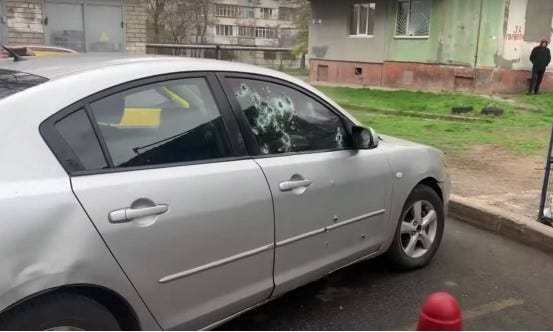

NOTE: There are videos of the crime scene with a corpse and plenty of blood, I spared you that.
Vladimir Putin’s “Easter” Offensive in Donbass
It’s not been easy to get a firm handle on how the attacks are progressing, but at the bare minimum, it’s going quickly for Moscow’s troops, but they’re advancing some.
The town of Kreminne, to the north-west of Severodonetsk, appears clearly to be one focus of Russian Federation, here apparently there was a full-dress assault. As I write this the UAF has said they’re still holding it. The RF also appears to have put in attacks at Rubizhne, another villages on the northern approaches to Severodonetsk. So at a guess one short-term terrain objective for the Easter offensive is Severodonetsk. Towards the end of the day RF state media published a video of fighters hanging a flag on a sign at the entrance to Rubizhne but I’m not sure what that proves. According to the Popasna military administration head, RF forces were inside the town and street fighting was in progress.
The second hard push seems to be south of Izium. UAF reports said RF formations attacked or fired lots of artillery in the direction of the villages Suligovka and Dibrivne, but did not advance south from there. Along with the JominiaAtWar map I’ve attached two close-ups of the Severodonetsk and Izium sectors, so hopefully that’s enough graphics to make understandable all the place names and directions.
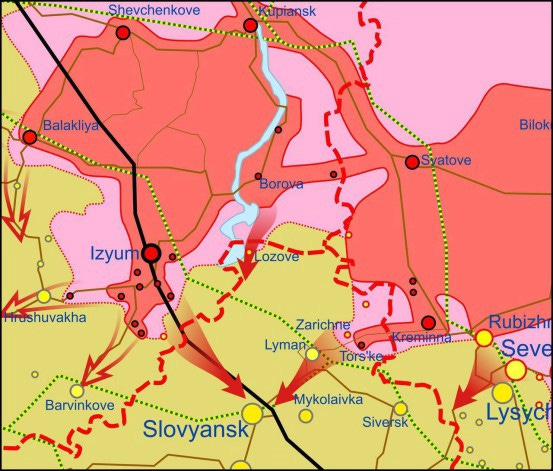
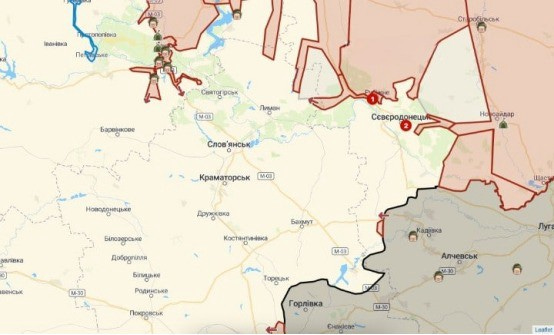
A possible third push, or perhaps advance by forces released from the siege of Mariupol, came in the southern sector of Donbass, with RF forces reported attempting to advance past the towns of Novo Selivka, Rivnopil and Storozhive — all locations well known to those of you with patrol experience in Donbass’ Mariupol sector. No information of the size of the force or what it did.
According to Ukraine’s Army General Staff (AGS), on Tuesday evening/night the UAF launched what appears to have been a limited attack in the village Marynka, literally on the west suburbs of Donetsk, and they say they have control of the place. Along with Horlivka and Avdievka, this area is either a bone in the RF throat or a 2–3 UAF brigades waiting to be cut off. For practical purposes, despite almost two months of combat, the lines from the start of the war haven’t moved in this area.
Ukrainian officials now, 36–48 hours into the offensive, seemed pretty upbeat. Luhansk area defense head Serhiy Hadai said that the main reason the RF is failing to break into places like Popasna and Rubizhne (possibly, an inaccurate statement) is precisely because the UAF has been manning positions there for more than a month and digging in and perfecting defensive artillery fire patterns the whole time. In general, he has a point, in this war (and indeed in lots of them) if a defender gets a day or two to dig in it’s hard to kick him out of his holes.
President Zelensky in Tuesday evening speech said that he was “99 percent sure” Putin’s Easter offensive will fail. Presidential Advisor Oleksiy Arestovych — who is getting a reputation for skill at putting the very best spin on any development — said the RF offensive cannot succeed because the RF lacks the force to do what it says it wants to do.
Overall, last 24 hours, the AGS counted ten full-dress RF attacks in Donbass, in consequence of which the RF, allegedly, lost 12 tanks, one artillery piece, 28 infantry fighting vehicles, an Su-34 fighter, a Ka-52 attack helicopter, four big UAVs and a cruise missile.
There were scattered anecdotal reports hinting towards serious RF casualties, but nothing conclusive. The Defense Ministery without saying where announced UAF units on Tuesday destroyed three companies from the RF’s elite 51st Airborne Assault Regiment, and one company from the equally elite 137th Airborne Assault Regiment. At a guess these two formations together would be maybe 400–500 men, and 50–70 vehicles; in other words a battalion tactical group not at full strength. The excellent mapsman JominiAtWar today put out an image dated to 18 April, in which he plots several RF airborne units to the south-east of Izium. So perhaps that was where this engagement was. Map attached.
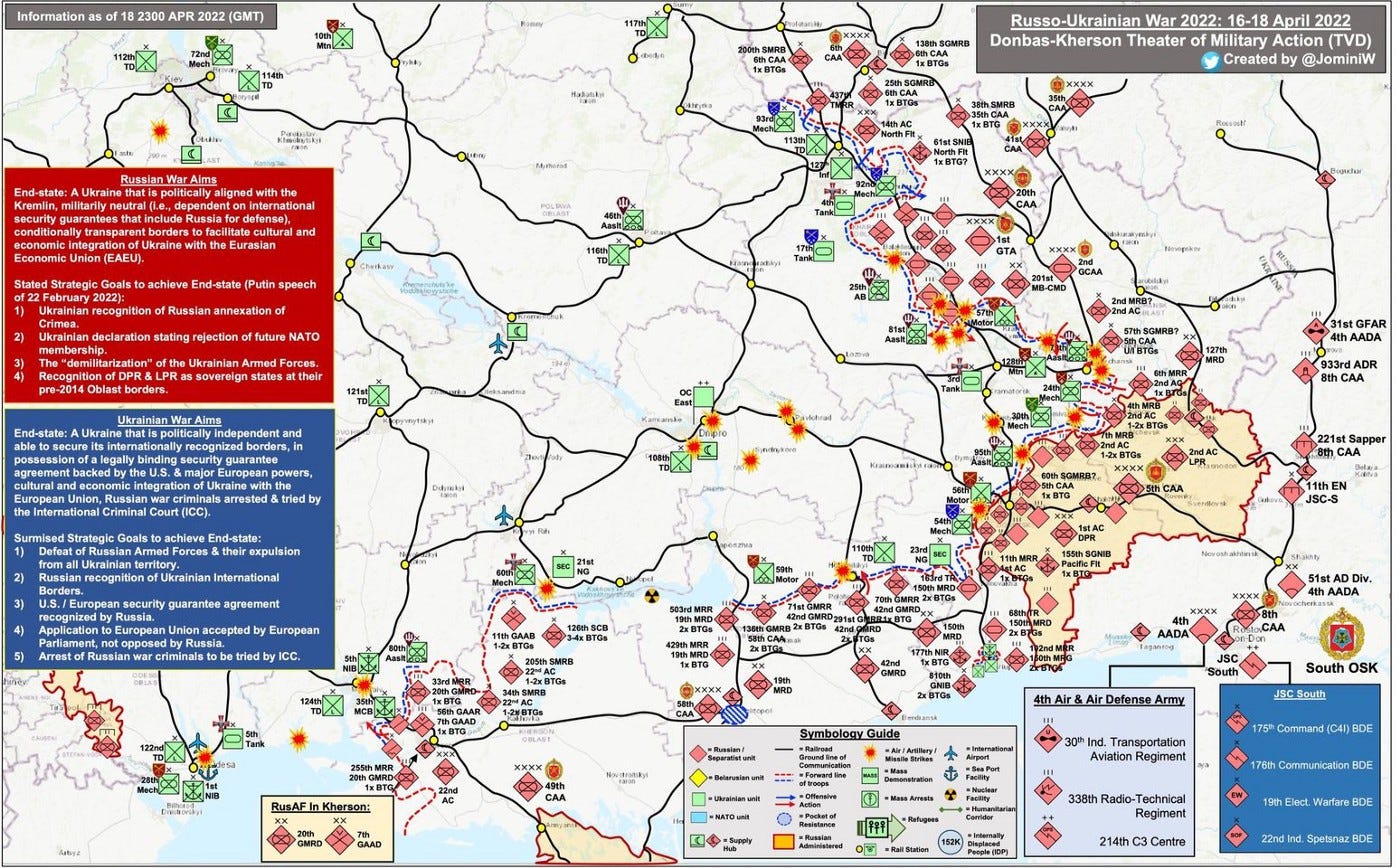
Hadai said that following RF nighttime attacks on Rubizhne and towards Severodonetsk, the civilian hospital in Novoaidar, in RF-controlled territory, was overwhelmed with more than 130 battlefield casualties.
Although the Ukrainians were pretty much unanimous that this is the big attack, the Pentagon on Tuesday said that more likely these are probes, because the RF still fields very substantial force not committed to combat. We will recall that once the war started, Pentagon and British intelligence estimates — made public anyway — tended to follow behind UAF estimates by 24–48 hours. But in any case, per the Pentagon, the RF has some 55,000 men in 78 battalion tactical groups in Ukraine, and the heavy majority of them are uncommitted to battle. A common UAF observation is: “And they are so beat up and full of soldiers who won’t fight, they are unlikely to be committed to battle any time soon.” But no matter who’s right, it’s just speculation at this point.
Mariupol:
In Mariupol itself, the RF kept its word yesterday and hit the Azovstal steel factory with at least one three-ton bomb, and followed it up with, according to defenders, all manner of explosives in the RF inventory: smaller air bombs, heavy howitzer shells, mortars, tanks and rocket artillery. The commander of both formations still inside the factory, the Marines and Azov Regiment, made public appeals overnight for some kind of ceasefire or third-party intervention to allow civilians and wounded to escape. As I write this, there had been no reports of any evacuation at all from the steel mill.
As an aside, I ran across a report today that claimed that a key reason the steel factory is so hard for the RF to break into, is that it was built by the Soviets with an eye towards keeping it operational after a thermonuclear exchange with the US, and that there are six stories of underground galleries and tunnels and chambers underunning the whole factory complex. If this is true, then whatever the UAF has in the factory will be immune to whatever firepower the RF deploys, until such time the RF finds troops willing to go down into the debris and tunnels and try to dig the Ukrainians out.
Since the surface of the factory, to all accounts, is a complete maze of fallen walls and knocked-down buildings, the RF’s task is more complicated, because tanks and infantry fighting vehicles can’t drive across that kind of rubble. I read an Estonian Defense Ministry analysis today that basically said that if ammunition and food hold out, the Marines and Azov in the Azovstal steel mill could fight on for months. If that is true, it will conflict with Kremlin plans to finish the war and declare victory in two weeks.
South: Little movement reported but more shelling of Mykolaiv. I get the impression that both sides are waiting for the Mariupol siege to resolve itself, before making any dramatic moves in this sector.
Occupation news: Apropos of Kuleshov’s murder in Kherson today, I thought it would be useful to throw out some statistics compiled by Ukraine’s Prosecutor General, Kherson region, as of 18 April. According to them, RF forces have “kidnapped” (i.e., detained for whatever reason) 155 people, of whom 69 are still being held. Who has been arrested? According to the prosecutor’s office, it was 34 local officials, 14 businessmen, 12 institution heads, three lawyers, and two journalists. In other words, under normal circumstances, not the profile of a group of people inclined to petty crime, but, almost exactly the kind of people who, if loyal to their country, would have any number of friends, relatives, colleagues and acquaintances potentially willing to take action about that, and maybe violently. As I noted earlier, the longer RF occupation goes on, under present shooting war circumstances, the more violent the resistance will become, and that will trigger RF crackdowns which will trigger more violent resistance.
At this rate, in about six months, there will be any number of European leaders and do-gooders who will be wringing their hands and at a loss that on the edge of the world’s most civilized and advanced continent, a process of murder, repression and counter-murder is the order of the day, and how could such an awful thing have happened and look it’s spilling over into the EU. The answer will be, because no one is did anything about it right now. Violence spirals and we are sitting at the start of the spiral.
Stuff for the UAF — Today was a red letter day for foreign promises of military assistance to Kyiv
The MiG-29s that weren’t: Without a doubt the most interesting development was an announcement yesterday by the Pentagon that the US absolutely positively has not sent Ukraine any fighter jets, followed by an announcement this morning from the Defense Ministry that in fact No One has sent Ukraine any combat aircraft. Meanwhile the aviation blogosphere was full of reports that 21 1990s-era MiG-29s, bought from Moldova by the US to use in training and then mothballed, would be sent to Ukraine not as aircraft, but rather air frames to be used as spare parts. No doubt this is all part of the theater NATO nations are still engaging in that they aren’t going to send Ukraine weapons suitable for striking Russia. In any case, the electronics in these planes is outdated. Upgrades are possible, but Ukraine’s factory for doing that, in Lviv, is likely pretty beaten up from RF missiles. So probably some east European NATO country will get the upgrade contract.
Dutch Prime Minister Mark Rutte announced the decision to supply Ukraine with heavy weapons, including armored vehicles. Scattered Ukrainian news agencies ran the news with the headline “We’re not Germans”.
We.Are.Germans: Today Marcus Laubenthal, vice general inspector of the Bundeswehr, told German media that Ukrainian ambassador to Berlin Andriy Melnyk (featured in a previous report) was being unfair by claiming over and over on the news talk shows Germany isn’t trying to help Ukraine. The fact is, Laubenthal claimed, Germany would be glad to help Ukraine but unfortunately there is no reserve equipment, all the German combat vehicles Ukraine is begging for are designated parts of a NATO quick reaction unit.
This would be more credible if German governments on both sides of the Bundestag aisle, despite ownership of Europe’s richest economy, had not for the past three decades underfunded defense and left it to others to pay for security.
Get out dem big guns: Assorted news reports from Canada, Britain and the US seemed to confirm that the “artillery” those countries will provide Ukraine will be a weapon called an M777 howitzer, which is a fairly modern towed artillery piece capable of firing every gee-whiz, high-tech 155mm munition those countries have developed. It performed well in Afghanistan and the Ukrainians, skillful gunners that they are, should have little trouble fielding the weapon.
The real question is how spiffy will the 155mm ammunition that comes with the guns be? Are these 19th century advocates of the single trail (look it up) willing to give the Ukrainians rocket-assisted shells, in which case these guns will likely out-range all cannon and artillery the RF has in the field. Will these English-speakers offer very expensive but devastatingly effective laser-guided munitions, which would allow a single UAF special forces trooper hiding in the RF rear echelons to pick off tanks and anti-aircraft systems, by painting them with a laser pointer? It’s now possible.
Tusend tak — The Norwegians in their unassuming way — other nations take note — didn’t waste a lot of energy talking about what they were going to do, they just announced today that they had handed over 100 Mistral anti-aircraft missiles to the Ukrainians. As far as I know this is Norway’s first lethal weapons delivery to Ukraine. This is a 50-year-old technology and 100 missiles in this war is not a lot. But Norway is a top 20 arms exporter, so I will be very curious as to what Norways’ next arms delivery to Ukraine will be.
Boris and Brimstone — Britain’s Prime Minister clearly has a bone in his teeth, and I will leave it to you as to whether a bulldog metaphor also is appropriate. In any case, today, Boris Johnson announced Britain was planning to send Ukraine Brimstone air-to-surface missiles, which are excellent against tanks, and anti-ship missiles to boot. Of course, promises won’t stop the Russians.
Czech quality — Today Czech Defense Minister Jana Cernochova announced Prague would be glad to repair UAF tanks and armored personnel carriers. According to news reports bang-up UAF T-64s will be the first in line. This statement, although unsurprising, no doubt there are several Czech state firms that will profit healthily from the business, is one solution to the Kremlin’s missile bombardment of Ukrainian military infrastructure. NATO may not wish to fight Russia, but they are perfectly happy to be Ukraine’s outsourced mechanic and supplier, and even Vladimir Putin is probably not so stupid as to bomb Prague.
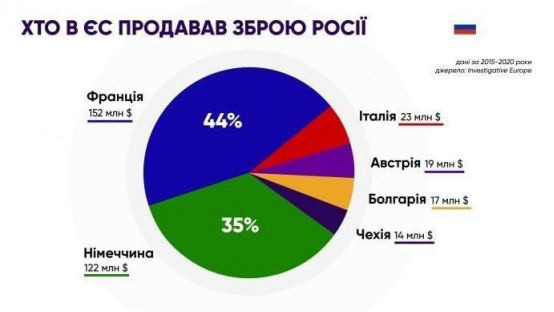
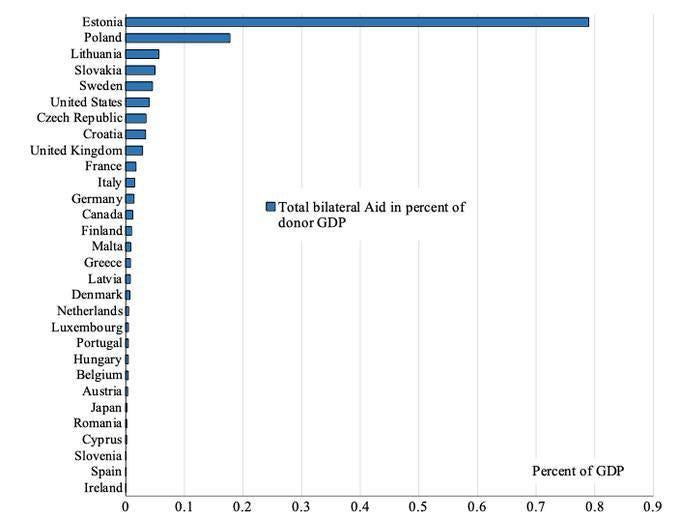
I’ll close with some economics graphics. The pie chart is weapons sales to Russia by nation. France is blue, Germany is green. The bar graphic is financial support to Ukraine relative to GDP.